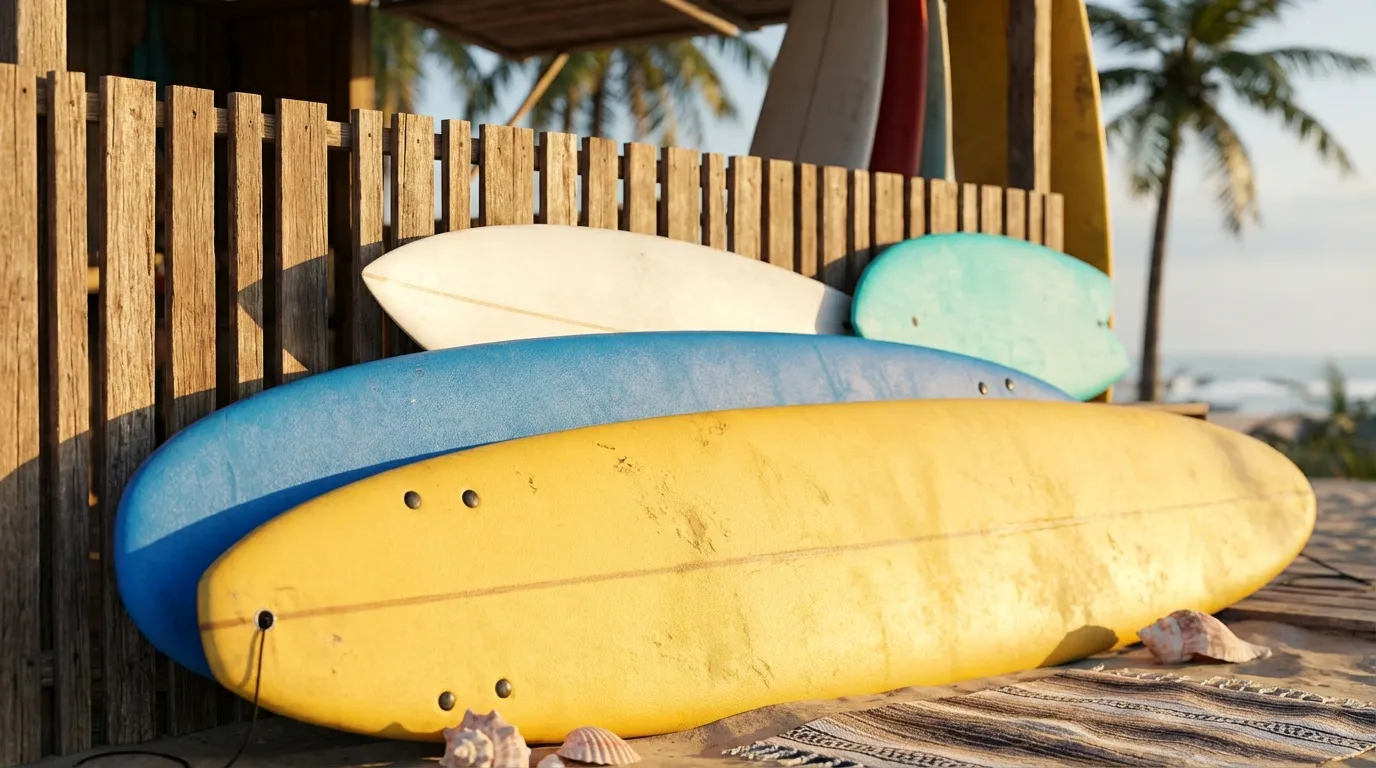
Choosing a surfboard is one of the most defining decisions in your surfing. The wrong board holds your progress back for months; the right one lifts you to the next level in a handful of sessions. Volume, length, shape: let's run through the criteria that genuinely matter so you can find the board that suits your level.
Why volume is the number one criterion
Before you worry about length or shape, the first question is: how much volume do I need? Volume, measured in litres, determines a board's buoyancy. The more it floats, the easier it is to paddle, pop up and catch small waves. The less it floats, the more technique and power you'll need to make it work.
The right volume depends on your weight, your level and the waves you surf. Here's a starting formula:
- Complete beginner: weight (kg) × 0.65 to 0.80. A 75kg surfer should be looking for 49 to 60 litres minimum, and often more.
- Intermediate: weight (kg) × 0.35 to 0.55. As your level climbs, you need less volume to perform.
- Advanced / performance: weight (kg) × 0.25 to 0.35. A 70kg pro can surf on 17 to 24 litres.
On small-wave days, which are common at many UK beach breaks, always add 5 to 10 litres to your usual volume. More volume means more waves caught, which means faster progress.
Length: why the inches matter
A board's length is measured in feet and inches (for example, 6'2" = six foot two = roughly 188cm). The general rule: the longer the board, the easier it is to paddle and the more stable it is; the shorter it is, the more manoeuvrable and quicker to turn.
For an adult beginner, a board under 7 foot is best avoided. Below that mark, the board lacks the float to paddle efficiently and get to your feet in soft waves. For most beginners and improvers, the comfort zone sits between 7'2" and 9'6", depending on the discipline you're aiming for.
The four main shapes
Beyond volume and length, a board's shape governs how it behaves in the wave. Here are the four broad families you'll come across in the surf shops.
The longboard
Between 9 and 10-plus foot, the longboard is the classic board for learning and for style. Its high volume (70 to 120-plus litres) lets you catch a maximum of waves, even very small ones. The signature longboard moves, noseriding and cross-stepping, are a whole school of surfing in their own right. There are two main strands: the performance longboard (thinner, more rocker) and the classic noserider (flatter, wider). For a beginner, a noserider or an all-round longboard is spot on.
The funboard / mini-mal
From 7 to 8'6", the funboard is the transition board par excellence. It marries the buoyancy of a longboard with sharper manoeuvrability. It's often the second board you'll own, once you've learned on a longboard. Widely available second-hand, it's also excellent value for the first 12 to 24 months of regular surfing.
The fish
Short (5'6" to 6'4"), wide and thick, the fish is recognisable by its forked swallow tail. The design dates back to the 1970s and remains hugely popular today for soft, mushy waves. Its width gives it more volume than a shortboard of the same length, and its wide tail delivers impressive speed and responsiveness on flat sections. The fish suits intermediate surfers after some glide in mediocre conditions.
The shortboard
The performance board par excellence: between 5'8" and 6'4", thin, light and with plenty of rocker (curve). The shortboard demands technique, power and a faultless read of the wave. It isn't suited to beginners or shaky intermediates. If you want to move onto a shortboard, progress first on a funboard until you've mastered bottom turns, top turns and cutbacks on shoulder-high waves and above.
Comparison of the four board types
| Type | Typical length | Typical volume | Recommended level |
|---|---|---|---|
| Longboard | 9'0" – 10'2" | 70 – 120 L | Beginner to advanced |
| Funboard / mini-mal | 7'0" – 8'6" | 50 – 72 L | Improver to intermediate |
| Fish | 5'6" – 6'4" | 32 – 46 L | Intermediate to advanced |
| Shortboard | 5'8" – 6'6" | 22 – 35 L | Advanced to expert |
New or second-hand?
The second-hand surf market is extremely active. For a beginner, buying a used board has several upsides: the price, of course, but also the fact that first boards tend to pick up knocks and dings (small cracks), which stings a lot less on a bargain board than on a pricey new one.
Buying second-hand
Local surf-club noticeboards, community Facebook groups and the classifieds are full of longboards and funboards in good nick. Always check:
- No open dings (cracks that let water in, which yellow and waterlog the foam core)
- The rails (edges) aren't crushed or cracked along their length
- The leash plug is solidly sealed
- No delamination (the skin lifting away from the core)
Buying new
Specialist surf shops and reputable online retailers carry excellent new boards. Steer clear of boards sold in general sports superstores: they're usually made with lower-grade materials (polyethylene rather than EPS or PU) and are sorely lacking in stiffness.
Brands worth a look
The surfboard market is vast. Here are a few reliable names by category.
Beginner and intermediate boards
- Torq: highly regarded for its epoxy/sandwich construction (TET technology), light and hard-wearing. Excellent value for funboards and mini-mals.
- NSP: another epoxy benchmark, with a solid beginner range and proven shapes.
- Softech: a soft-top (foamie) specialist, extra-safe and perfect for learning as a family.
- Beach Beat and other UK shapers: home-grown boards built for local conditions, a smart shout once you know what you want.
Custom and hand-shaped boards
For intermediate and advanced surfers, hand-shaped boards made locally offer boards perfectly tuned to your regional conditions. UK shapers in Cornwall, Devon and further afield, alongside names like Channel Islands (high end), are safe bets. A custom board is a bigger commitment, but one worth making once your surfing justifies it.
If you're torn between two volumes, always go for the bigger one. It's far more frustrating to miss waves for lack of float than to find your board a touch easy to handle.
The essential accessories
A board on its own doesn't get you far. Here's what else you'll need:
- The leash: match its length to your board. A 9' for a longboard, a 6'6" for a shortboard. Replace it every year or two.
- Wax: rubbed onto the deck (top) for grip. Choose a wax to suit the water temperature (tropical, warm, cool or cold) — cold or cool water for most of the UK year.
- The wetsuit: a subject in its own right, covered in our men's surf wetsuit guide.
- The fins: often supplied with the board, but check the fitting system (FCS, FCS II or Futures). Some shops sell fins separately to fine-tune how the board rides.
To go further with your kit, read our full surf gear guide and browse our surf advice section to progress quickly.
FAQ: choosing a surfboard
What board should someone weighing 90kg get to start out?
At 90kg as a complete beginner, you'll want at least 65 to 72 litres of volume. A thick 9'6" longboard (3 inches) or a very voluminous 8'6" funboard will do the job. Avoid dropping below 65 litres: you'd spend most of your time paddling without getting to your feet.
Can you learn straight away on a shortboard?
No, it's a common and costly mistake. A shortboard (under 6'6", below 35 litres) demands a mastery of the pop-up, wave positioning and turns that a beginner simply doesn't have yet. The frustration of missing waves and falling on every attempt risks putting you off for good. Start on a comfortable volume and size down gradually.
EPS/epoxy or PU/polyester: what's the difference?
EPS/epoxy boards (expanded-polystyrene core plus epoxy resin) are lighter and more ding-resistant than traditional PU/polyester boards (polyurethane core plus polyester resin). For a beginner, EPS is often recommended for its durability. Performance shortboards frequently stay in PU for their more classic flex.
Should you buy new or second-hand for a first board?
For a first board, second-hand is often the wisest choice, provided you check the condition carefully (no open dings, rails in good shape). You'll save a good chunk against new, and you can resell easily at a similar price if you change board after a few months. Longboards and funboards in good nick hold their value well.
When is the right time to size down in volume?
It's time to size down when you've mastered: (1) a quick, consistent pop-up even on rolling waves, (2) the basic bottom turn (the turn at the base of the wave), and (3) reading the peak — you pick your waves and position yourself correctly. That stage usually arrives after 20 to 50 sessions, depending on how often you get in and how committed you are.