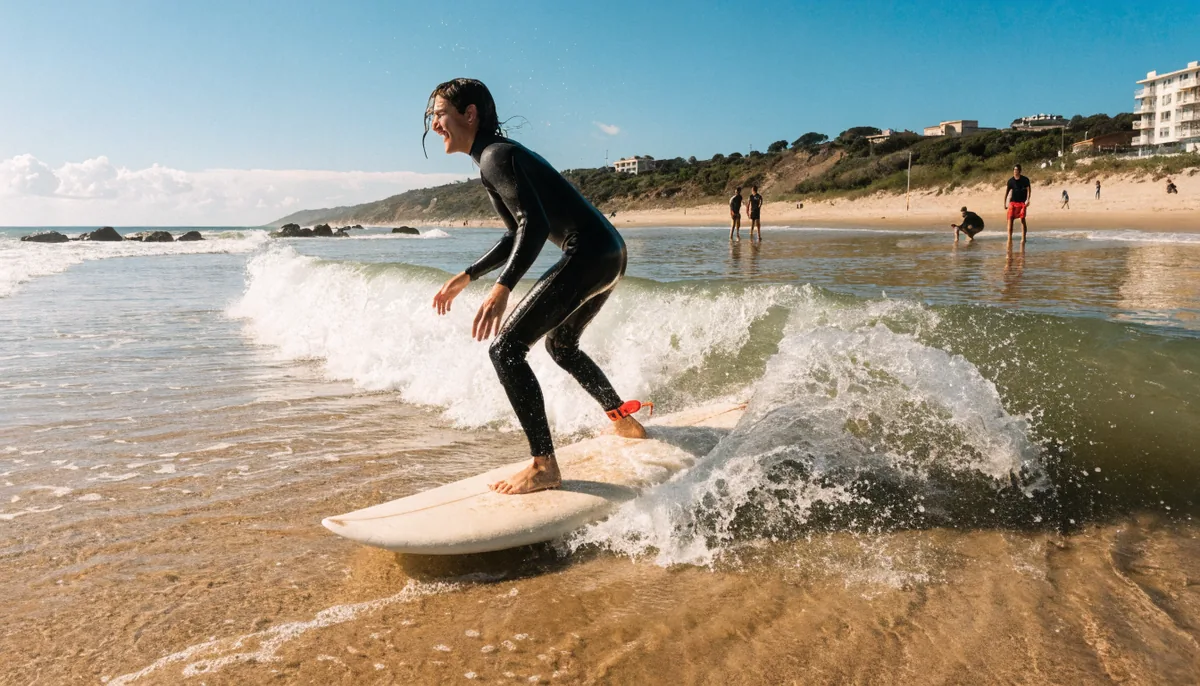
Surfing is one of the most accessible and exhilarating sports there is. Standing up on your board, carried by the energy of a wave, that first ride stays with you forever. But jumping in without any preparation can quickly become frustrating, or even dangerous. Here's everything you need to get started properly: choosing your board, understanding the ocean, nailing your pop-up and finding the right spots around the UK.

Choosing your board
Volume, length, shape: the essential criteria for picking the right board for your level and build.
See the gear guide arrow_forward
Reading the waves
Understanding peaks, rights, lefts and picking the right moment to paddle out: the key to progressing fast.
More on surfing arrow_forward
Best UK beginner spots
Croyde, Polzeath, Newquay: the most accessible and forgiving beginner beaches on the North Devon and Cornwall coast.
Discover the spots arrow_forwardChoosing your first surfboard
Choosing your board is one of the most important decisions in your surfing journey. A common beginner mistake is reaching for a performance board too soon, when plenty of volume makes learning far easier.
The longboard (9' and up)
The longboard is the gold standard for learning. Its length (typically 9 to 10 foot, around 270 to 300cm) and generous volume (80 to 100-plus litres) give unbeatable stability. You'll be up on your feet quickly, and mushy waves are easy to ride. The trade-off is that it's bulky to carry and harder to manoeuvre in steeper waves. For an average-build beginner, a 9'0" to 9'6" board with 75 to 90 litres of volume is ideal. Expect to pay somewhere between £350 and £650 new.
The mini-mal or funboard (7' to 8'6")
Sitting between a longboard and a shortboard, the mini-mal (also called a funboard) measures 7 to 8'6" and offers 50 to 70 litres of volume. It's noticeably more manoeuvrable than a longboard while still holding decent stability. It's often the board beginners move onto after a few months on a longboard, and it lets you start tackling slightly punchier waves. Budget: between £300 and £550 new.
Rule of thumb for choosing your volume: take your weight in kg and multiply by 0.6 to 0.8 if you're a complete beginner. A 70kg (11 stone) surfer should ideally start on a board of at least 55 to 60 litres, or more.
What nose and tail shape?
For a beginner, a rounded or wide nose is best: it improves lift on smaller waves. A wide tail (squash or swallow) gives more stability and drive. Avoid pointy, shortboard-style outlines until you've built a solid foundation in standing up and turning.
Understanding and reading the waves
Before you even set foot in the water, spending five minutes watching the waves from the beach genuinely transforms your session. The ocean isn't random: it follows patterns you can learn to read.
Anatomy of a wave
A wave has several parts: the peak (the highest point, where it breaks first), the lip (the breaking crest), the face (the smooth wall you ride) and the whitewater (the foamy part that's already broken). As a beginner, you'll start in the whitewater: the wave has already broken, the push is steady and powerful, and it's perfect for learning your pop-up.
Sets and lulls
Waves arrive in sets, separated by calmer spells known as lulls. Learn to spot these cycles from the shore: a run of 3 to 6 waves, then 2 to 5 minutes of calm. The lull is your window to paddle out to the peak. Also watch the direction of the current and keep an eye out for rip currents: channels where water pulls back out to sea, usually recognisable by darker, choppier water.
Rights and lefts
A wave breaks either to the right, to the left, or both at once (a closeout). A right peels away to the surfer's right when facing the beach; a left peels to their left. To make the most of a ride, look for waves that break progressively along their length rather than closeouts that collapse all at once.
The pop-up: the fundamental technique
The pop-up is the movement that takes you from lying on your board to standing up. It's THE fundamental move in surfing, and it's best drilled on dry land first.
Your position on the board
Lying on your board, your feet should sit just above the kick (the raised tail), with your chest centred on the board. Your arms sit either side, roughly at hip height, not too high. If your board's volume is well matched to you, the nose should sit just above the water's surface: 2 to 5cm is plenty.
The pop-up sequence
- Paddle hard: as soon as you feel the wave pick you up, three or four powerful strokes.
- Push up on your hands: place your hands flat at chest height and push up while bringing your feet underneath you.
- Front foot first: the front foot (left for a regular, right for a goofy) lands between your hands, with the back foot following immediately.
- Stand up in one motion: never pass through a kneeling position — the pop-up should be a single fluid movement, like an explosive press-up.
- Standing posture: knees slightly bent, feet at 45° to the rail, arms out a little for balance, eyes forward, not down at the board.
Practise your pop-up on dry land, on the sand or a yoga mat, at least 20 to 30 times before your first session. Muscle memory is your best friend once you're in the water.
Water safety: the essential rules
Surfing is a sport where safety isn't optional. The ocean stays a powerful, unpredictable environment, even on a calm-looking day.
The basic rules
- Never let go of your board: your board is your buoy. If you fall, it will always bring you back to the surface.
- Keep your leash in good condition: check regularly that the leash (the cord linking your board to your ankle) isn't frayed or twisted. A snapped leash in the shore break can be genuinely dangerous.
- Priority rules: the surfer already riding a wave has absolute priority. Never drop in on a wave someone else has already caught.
- Steer clear of swimming areas: always surf within zones flagged for board sports, never in the middle of a designated swimming area.
- Get out in time: recognising fatigue is a skill in itself. A tired surfer makes poor decisions. Head in before you're exhausted.
The wetsuit
UK sea temperatures vary hugely by coast and season, ranging from around 8°C in winter to 18-19°C at the height of summer in the south-west. A 4/3mm wetsuit is essential from October to April on most UK coasts, with boots, gloves and a hood recommended in the coldest months. A 3/2mm will do for a warm summer session in Devon or Cornwall. For more detail, see our surf gear guide.
The best beginner spots in the UK
The South West of England has some of the best beginner surf in Europe: long sandy beaches, gentle beach breaks and a huge network of surf schools built around exactly this kind of learning wave.
A classic, forgiving beach break with plenty of whitewater to practise on, backed by a big village full of surf schools and board hire. One of the most established learning beaches in the country.
A sheltered, gently sloping beach that stays manageable even when it's a bit bigger elsewhere. RNLI lifeguards patrol in summer and it's popular with families and first-timers.
A vast, sandy beach with space to spread out and consistent, easy-to-read whitewater. Newquay itself is the UK's surf capital, with schools, shops and hire on almost every corner.
A few more spots worth your attention: Saunton Sands for its sheer length and mellow conditions, Woolacombe for its Blue Flag beach and reliable beginner waves, and Perranporth with its wide, sandy break and relaxed vibe. For a full map of UK spots, head to our destinations page.
The stages of progression
Learning to surf takes time, and that's exactly what makes it such a rewarding sport. Here's a rough guide to progress:
- Sessions 1 to 5: mastering the pop-up, catching whitewater straight on, standing up for 3 to 5 seconds.
- Sessions 6 to 15: catching whitewater at an angle, small turns, understanding where to sit in the line-up.
- Sessions 16 to 30: starting to catch unbroken waves, first attempts at bottom turns, moving onto a mini-mal.
- Beyond 30 sessions: working on frontside and backside turns, reading the peak, session strategy.
Consistency beats duration. Two one-hour sessions a week will get you further, faster, than a single four-hour marathon. And don't hesitate to book a few lessons with a qualified instructor: getting solid technique from the start will save you years of bad habits. Also check out our Surf section to keep progressing.
FAQ: learning to surf
What age can you start surfing?
Surfing can be learned at any age. Many surf schools take children from around 6 or 7 (on very large foam boards), and plenty of adults pick it up for the first time well into their 40s or 50s. The main requirement is being a confident swimmer and comfortable in open water. The earlier you start, the faster your balance and wave-reading develop naturally.
How much does a beginner surf lesson cost?
A group lesson at a UK surf school typically costs between £35 and £55 for a two-hour session, usually including board and wetsuit hire. Multi-day courses of four or five lessons are often available for around £150 to £220. To fully kit yourself out as a beginner (board, wetsuit, leash, wax), expect to pay £350 to £700 new, or £150 to £350 second-hand.
Do you need to know how to swim before learning to surf?
Yes, without exception. Being able to swim at least 25 to 50 metres comfortably is a minimum requirement for surfing safely. If your leash snaps or you get caught in a strong current, you'll need to be able to swim yourself back to shore. Most surf schools require this level of swimming ability before accepting beginners.
What's the difference between regular and goofy?
A "regular" surfer rides with their left foot forward on the board (facing a wave breaking to their right). A "goofy" surfer rides with their right foot forward. It isn't a conscious choice, it's instinctive: usually the same foot you'd lead with on a skateboard or snowboard. To work it out, notice which leg you put forward when you slide across the floor in socks.
Can you learn to surf alone, without lessons?
Technically yes, but it isn't recommended for beginners. Without guidance, you risk picking up bad technical habits that are hard to shake later, and more importantly, missing the safety rules and etiquette you need in the water. Two or three lessons are usually enough to get the basics right: it's an investment that saves months of progress.